Independent reviews•We buy everything we test•Updated January 2026
How we test
We test every watercolor paper and sketchbook using a standardized process. Each surface goes through six tests: a flat wash for even coverage, wet-on-wet for blending, glazing for layering, lifting for error correction, scrubbing for durability, and dry brush for texture. We use the same pigments — Daniel Smith Ultramarine Blue and Burnt Sienna — and the same brushes across all papers, so the only variable is the paper itself. Testing happens over multiple sessions to account for humidity and temperature differences, and every product is purchased with our own money.
The Strathmore 400 Series is the pad we always recommend to students and beginners who want a reliable surface without the sticker shock of professional cotton papers. At under fifteen dollars for a twelve-sheet pad, you can paint freely, experiment, and make mistakes without feeling like you are burning money.
Affordable enough for daily practice without worrying about wasting paper
Handles light wet-on-wet washes surprisingly well for wood pulp
Acid-free composition means paintings will not yellow over time
Widely available at craft stores and online retailers
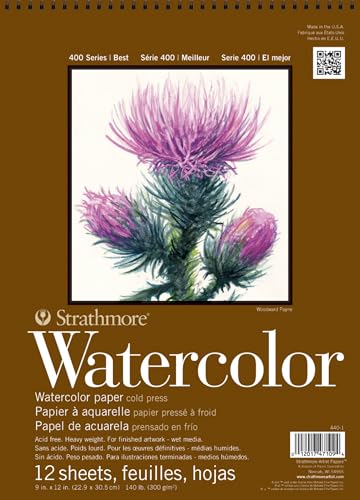
The Strathmore 400 Series is the pad we always recommend to students and beginners who want a reliable surface without the sticker shock of professional cotton papers. At under fifteen dollars for a twelve-sheet pad, you can paint freely, experiment, and make mistakes without feeling like you are burning money. During our tests, we found that light wet-on-wet washes went down smoothly. Soft sky gradients and simple background washes looked clean and even. The synthetic sizing gives the surface enough resistance that pigment does not just soak in immediately, which is reassuring for newer painters learning water control. Where the Strathmore 400 starts to show its limitations is with more demanding techniques. Aggressive scrubbing with a stiff brush caused the surface to pill after just a few strokes, and lifting dried color left behind a noticeable ghost rather than returning to clean white. Glazing worked for two or three layers, but beyond that the paper started to feel tired and muddy. Granulation effects are muted compared to cotton. The wood pulp fibers just do not have the same irregular texture that makes minerals sparkle. That said, for the price point, this paper punches well above its weight. If you are learning brush control, practicing value studies, or just want a worry-free sketchbook surface, the 400 Series is a solid starting point. Move up to cotton when the paper itself starts to hold your painting back.
Pros
Affordable enough for daily practice without worrying about wasting paper
Handles light wet-on-wet washes surprisingly well for wood pulp
Acid-free composition means paintings will not yellow over time
Widely available at craft stores and online retailers
Sturdy 140lb weight resists moderate buckling
Cons
Surface pills and tears under aggressive scrubbing or repeated lifting
Colors appear noticeably duller than cotton papers once dry
Limited wet working time, washes dry quickly and can leave hard edges
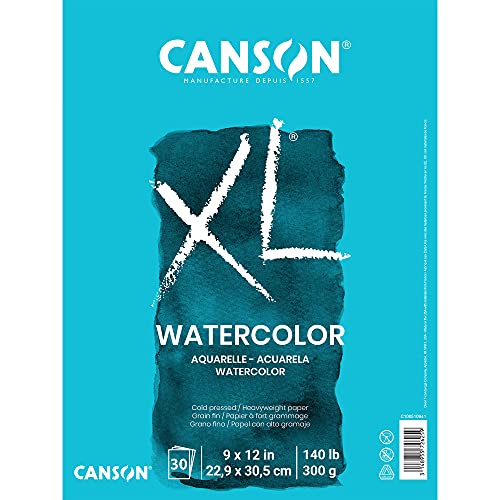
The Canson XL is the paper you grab when you need sheer volume at the lowest possible cost. With thirty sheets in the standard nine-by-twelve pad, it works out to well under fifty cents per sheet, which makes it ideal for warm-up exercises, thumbnail studies, and technique drills where outcome matters less than mileage. The cotton blend in the pulp does give it a marginal edge over pure wood pulp competitors. We noticed slightly better pigment adhesion and a touch more resilience when lifting, though the difference is subtle. Wet-on-wet washes spread reasonably well, but the paper dries fast, so you need to work quickly to avoid hard tide lines. We found that pre-wetting both sides and taping the sheet to a board helped enormously with buckling, which is otherwise the biggest annoyance here. Glazing is limited to two or three layers before the surface starts to feel overworked and gummy. Do not attempt aggressive scrubbing, the fibers tear almost immediately. Where the Canson XL earns its place is pure accessibility: it is stocked everywhere from big-box craft stores to grocery store art aisles, and the price means a complete beginner can go through dozens of sheets building confidence before spending more. Think of it as training wheels. It will teach you the basics of water control and pigment behavior, and once you feel ready, stepping up to cotton will feel like a major upgrade.
Pros
Lowest price per sheet of any paper in this roundup
Cotton blend gives a slight performance edge over pure wood pulp
Generous sheet count per pad, great for high-volume practice
Fold-over and spiral formats are convenient for plein air painting
Cons
Buckling is noticeable even with light washes unless taped down
Surface breaks down quickly with scrubbing or masking fluid removal
Colors dry noticeably duller than on professional-grade papers
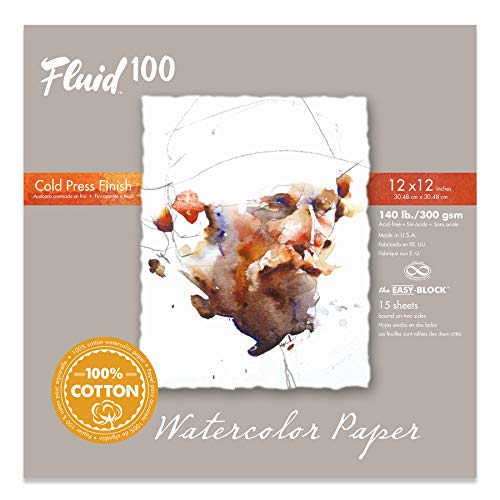
Blick Premier punches well above its weight class for a mid-range watercolor paper. After running it through a full battery of tests, we were genuinely impressed by how well it holds up under heavy wet-on-wet applications. We laid down three consecutive washes on a single area and the paper maintained its integrity without any sign of pilling or surface breakdown. The gelatine sizing does its job well, allowing us to lift color back to near-white even after the paint had dried for several minutes. Glazing works nicely here too, with transparent layers building up cleanly without disturbing what is underneath. Where the paper falls a bit short is in raw color intensity. Comparing side by side with Arches or Fabriano, pigments just do not land quite as brightly on the Blick Premier surface. Scrubbing is possible but you will hit the paper fibers faster than you would on a more heavily sized sheet. That said, for the price you are paying, these are minor compromises. The cold press texture has a pleasant, consistent tooth that takes detail work reasonably well without being overly rough. If you are an intermediate painter looking for real cotton paper without the premium price tag, this is one of the best options available. It is the paper we recommend most often to students moving up from cellulose. Note: Blick Premier is a Dick Blick exclusive and is not sold on Amazon. The link above redirects to the closest equivalent (Fluid 100 block). For the best price on Blick Premier, visit dickblick.com directly.
Pros
100% cotton mould-made paper priced 30-40% below Arches and Fabriano
Handles multiple wet-on-wet washes without pilling or warping
Gelatine sizing allows for clean lifting and corrections
Even color absorption with minimal pooling on flat washes
Cons
Slightly less forgiving with scrubbing compared to premium brands
Pigments dry a touch flatter than on Arches or Fabriano when compared side by side
Pad binding can make tearing out sheets cleanly a bit tricky
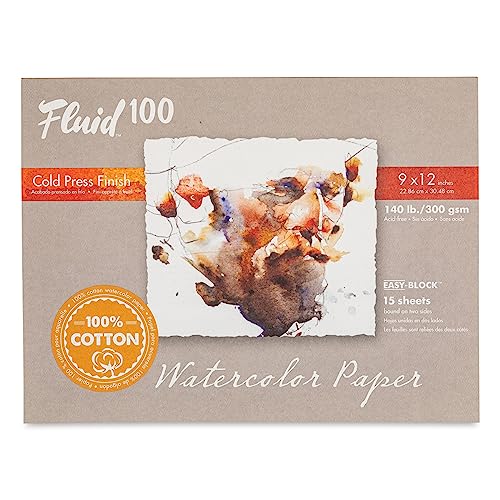
Fluid 100 is the paper we point people toward when they tell us they cannot afford Arches but want real cotton. At its price point, few other options deliver this level of performance. The 100% cotton, mould-made construction gives it a genuine professional feel, and the gelatine sizing works well enough that you can lift color, glaze in layers, and run wet-on-wet washes with real confidence. We painted a full landscape on a block sheet without any stretching or taping, and the paper stayed reasonably flat throughout, only showing minor cockling during the heaviest wash application. Lifting worked well when we pulled color within the first few minutes. After full drying, it was still possible but required more pressure. Glazing performance was solid. We layered four washes of Phthalo Blue and each read distinctly without muddying. Where you notice the budget positioning is in consistency. We have had sheets from different packs that felt slightly different in texture and absorption. The surface is also a bit less resilient under heavy scrubbing, so if you make a mistake and need to really work the paper, you will hit the fibers sooner than you would on Arches or Hahnemuhle. For the price, these are completely acceptable compromises. If you are an intermediate painter building skills or a professional who goes through a lot of paper for studies and practice, Fluid 100 is a smart, practical choice. Skip it if surface consistency is critical to your process.
Pros
Lowest price point for genuine 100% cotton mould-made paper
Gelatine sizing performs surprisingly well for lifting and corrections
Block format lies flat and eliminates the need for stretching
Handles wet-on-wet washes with minimal buckling at this weight
Cons
Sheet-to-sheet consistency can vary slightly between production batches
Surface is a bit more fragile under aggressive scrubbing than pricier options
Cold press texture is somewhat irregular compared to premium papers
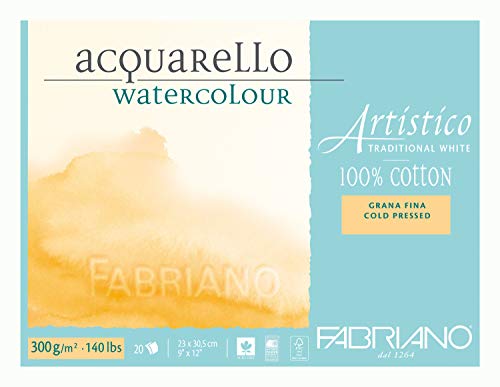
Fabriano Artistico is the paper we reach for when we want professional-grade cotton at a price that does not sting quite as much as Arches. The Artistico line uses synthetic sizing instead of gelatine, making it the go-to choice for vegan watercolorists. In our wet-on-wet tests, pigment flowed smoothly across the dampened surface with soft, feathered edges. The synthetic sizing absorbs water a bit faster than gelatine, so you do need to work slightly quicker, but the trade-off is a surface that feels almost velvety under the brush. Lifting was good but not perfect. We could pull color back cleanly within the first minute or so, but once dry, staining pigments locked in more firmly than on Arches. Glazing performed well through four or five layers before we noticed any muddying. Where this paper really shines is granulation: Daniel Smith Lunar Black separated into gorgeous particle textures in the cold press tooth. We also found it handled masking fluid without tearing when removed, though we would still recommend low-tack tape for edges. At roughly fifteen to twenty percent less than Arches per sheet, the Artistico is a strong choice for working painters who need reliable cotton paper without the top-tier price. Skip it if your practice depends heavily on lifting dried paint, where gelatine-sized papers have a clear edge.
Pros
Vegan-friendly synthetic sizing with no animal products used
Priced roughly 15-20% lower per sheet than Arches while performing at a professional level
Soft, absorbent surface is forgiving for wet-on-wet beginners
Excellent pigment granulation on textured surface
Handles masking fluid cleanly without tearing on removal
Cons
Less resistant to aggressive scrubbing than gelatine-sized papers
Colors can appear slightly more muted compared to Arches when dry
Dries a touch faster, narrowing the wet-on-wet working window
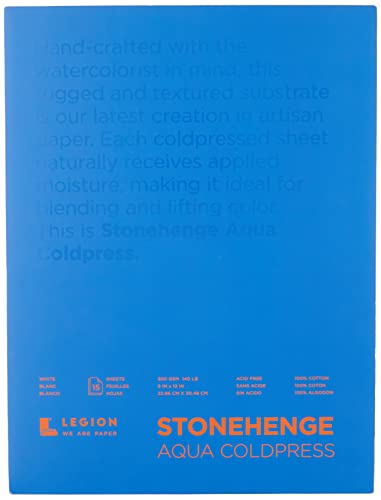
Legion Stonehenge Aqua occupies a unique niche in the watercolor paper world thanks to its synthetic sizing, which makes it a standout choice for mixed media artists. Where most cotton papers use traditional gelatine, the synthetic alternative here gives the surface different absorption characteristics. Water sits slightly differently on the surface, and you will notice that pigment sinks into the fibers a bit more permanently. This is actually an advantage if you plan to layer other media on top. We tested it with watercolor washes followed by colored pencil detailing, ink line work, and even light gouache highlights, and every medium bonded to the surface cleanly without any adhesion issues. For pure watercolor technique, wet-on-wet works well but the working window is a touch shorter than gelatine-sized papers. You need to move a bit faster. Glazing is solid, with layers building up cleanly, though the colors read slightly more matte than they would on a paper like Arches. The biggest trade-off is lifting. Once a wash has fully dried, pulling color back is considerably harder than on gelatine-sized surfaces. You can still make corrections, but it requires more effort and a stiffer brush. For painters who work exclusively in watercolor, there are better-optimized choices. If your workflow involves multiple media, or you want a paper that locks in your watercolor layers before adding other materials on top, the Stonehenge Aqua is genuinely excellent and hard to replace.
Pros
Synthetic sizing makes it well suited for mixed media applications
Takes ink, colored pencil, and gouache cleanly alongside watercolor
Smooth yet toothy surface that works well for both fine lines and broad washes
American-made with excellent quality control and consistency
Extremely durable surface that withstands heavy reworking
Cons
Synthetic sizing behaves differently from gelatine, requiring an adjustment period
Lifting is noticeably harder once paint has fully dried and set
Color intensity can appear slightly flatter than gelatine-sized papers
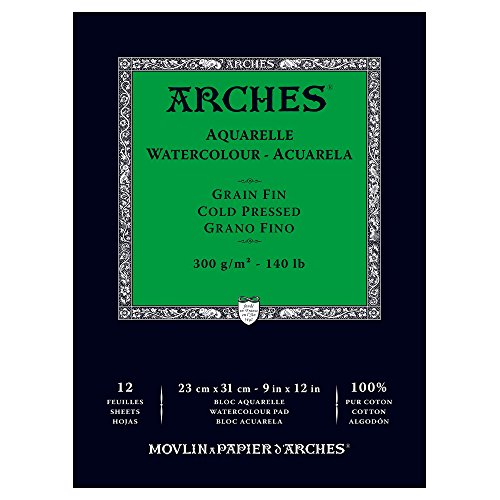
Arches Cold Press 140lb is the benchmark most watercolorists use when judging any other paper. During testing, the surface handled wet-on-wet techniques beautifully. We flooded it with clean water and dropped in concentrated pigment, and the color bloomed in smooth, controlled gradients without any unwanted hard edges. The gelatine sizing gives the surface a resilient quality that lets you lift color back to near-white even after a wash has fully dried, which is invaluable for correcting mistakes or pulling out highlights. We pushed it hard with a stiff bristle brush during scrubbing tests, and the fibers held together without pilling or tearing. Glazing is where this paper really excels: we layered six transparent washes and each one remained distinct, with no muddiness or color bleeding into layers below. The cold press texture provides enough tooth to grab pigment granulation in minerals like genuine ultramarine and raw umber, while still being smooth enough for detailed brushwork. Drying time felt consistent across the sheet, which tells us the sizing is applied evenly. The main downsides are price and the gelatine sizing, which rules it out for vegan painters. If budget allows, this is the paper to buy. If you are a student or paint casually, start somewhere cheaper and move up when the paper becomes a limiting factor.
Pros
Exceptional wet strength allows extended wet-on-wet working time
Handles repeated lifting and scrubbing without pilling or surface damage
Even, predictable washes with smooth color gradients
Pigments stay bright and distinct through 6+ glazing layers
Available in a wide range of formats and sheet sizes
Cons
Costs roughly 30-40% more per sheet than comparable professional papers like Fabriano Artistico
Gelatine sizing is not suitable for vegan artists
Slight batch-to-batch variation in sizing strength
Three factors matter most when you are learning, and everything else is secondary.
Paper weight is the most important spec to check before buying. Get 140 lb (300 gsm) and nothing lighter. Weight determines how much water your sheet can handle before it buckles and warps. At 90 lb, even a moderate wash will turn your paper into a crinkled mess, and you will spend more time fighting the surface than learning to paint. At 140 lb, the paper stays reasonably flat under normal wash conditions without any stretching or taping. Our paper weight guide explains the differences in detail, but the short answer is: do not go below 140 lb.
Texture is the second call to make. Start with cold press. Cold press paper has a slightly bumpy surface that catches pigment in small valleys and lets dry brush strokes skip across the peaks. This texture is forgiving in a way that smooth hot press paper is not. On cold press, a slightly uneven wash still looks intentional because the texture breaks up the edges. On hot press, every brush mark and streak is visible, which demands a level of brush control that most people have not developed in their first year. Cold press works for almost every subject and technique you will practice early on.
Sizing is the third factor. Sizing is the chemical treatment that controls how water spreads on the paper. Well-sized paper gives you a few seconds to manipulate your wash before it dries, which is important for blending and softening edges. Poorly sized paper absorbs instantly, locking in hard edges before you can adjust them. Student papers like Strathmore 400 have decent sizing for the price. Very cheap papers often have inconsistent sizing that causes unpredictable blooms and dry spots. Our paper types explained guide covers how sizing varies across brands.
Material (cotton versus wood pulp) matters less at the beginner stage than the three factors above. A well-made cellulose paper like Strathmore 400 will serve you far better than a poorly sized cotton paper, and it costs a fraction of the price. You will notice the difference cotton makes once you start attempting lifting, scrubbing, and multi-layer glazing, but those come later.
Budget vs quality: where to draw the line
There is a real, measurable performance difference between a $7 pad of Canson XL and a sheet of Arches. The question is whether that difference matters for what you are doing right now.
For daily practice, technique drills, and color mixing studies, budget paper is the right call. Canson XL and Strathmore 400 both handle flat washes, graded washes, and basic wet-on-wet work well enough to learn from. You can practice brush control, explore pigment properties, and fill entire sketchbooks without agonizing over cost per sheet. Both papers buckle somewhat with heavy washes, and neither lifts cleanly, but those limitations do not matter when you are building foundational skills.
Where budget paper falls short is in the techniques that separate intermediate painting from beginner painting. Try lifting a highlight out of a dried wash on Canson XL and you get a smudgy, rough patch instead of a clean bright area. Attempt five glazing layers on Strathmore 400 and the surface starts to pill, colors go dull, and the sizing breaks down. These are real limitations, but they only become frustrating once you have progressed past basic exercises.
A practical approach: keep two types of paper in your kit. Use a pad of affordable paper for daily practice, and keep a small stock of mid-range cotton paper like Blick Premier or Fluid 100 for paintings you actually want to finish. This gives you freedom to experiment without financial anxiety while still experiencing how cotton paper responds to more advanced techniques. When you compare the same painting done on cellulose versus cotton, the difference in luminosity and wash control makes the case for quality paper far more clearly than any guide can.
When to upgrade your paper
There is no fixed timeline, but there are clear signals that your paper is holding you back. If you find yourself consistently frustrated by hard edges forming in wet-on-wet washes, unable to lift highlights, or watching glazed layers turn muddy after the third pass, your technique may have outgrown your paper.
The first meaningful upgrade is from pure cellulose to a cotton-cellulose blend or an affordable 100% cotton paper. Blick Premier and Fluid 100 both offer genuine cotton performance at roughly half the cost of Arches. Washes spread more evenly, lifting becomes possible, and glazing layers stay cleaner. This is the upgrade that makes the most dramatic difference, and for many painters, these mid-range cottons are where they stay permanently.
The second upgrade, from mid-range cotton to premium cotton like Arches or Fabriano Artistico, is more subtle. You gain better batch consistency, more robust sizing, superior archival properties, and the confidence that your paper will handle whatever you throw at it. For a full comparison of top-tier options, see our professional-grade papers guide.
A useful benchmark: once you have painted at least fifty sheets and can consistently produce graded washes, control wet-on-wet blooms within a defined area, and layer two to three glazes without overworking, you are ready for cotton paper. Once you start selling work, exhibiting, or building a portfolio, upgrading to a premium brand is a sound investment in the longevity and quality of your finished pieces. Until then, paint as much as possible on paper you can afford to use generously.
Frequently asked questions
What is the best watercolor paper for beginners?
Strathmore 400 Series is the best starting point. It is affordable, widely available, and handles basic watercolor techniques well enough to learn on. Once your skills improve, upgrade to a 100% cotton paper like Blick Premier or Fluid 100.
Should beginners use cold press or hot press paper?
Start with cold press. The textured surface is more forgiving and works well with most watercolor techniques including wet-on-wet washes, dry brush, and blending. Hot press requires more control and is better suited for experienced painters doing detail work.
Is expensive watercolor paper worth it for beginners?
Not for practice sessions. Use affordable paper like Canson XL or Strathmore 400 to build your skills. When you start creating pieces you want to keep or frame, switch to a 100% cotton paper for its superior archival quality and painting properties.
What weight watercolor paper should beginners buy?
Always get 140 lb (300 gsm) paper. It resists buckling with moderate washes and does not require stretching. Thinner paper will warp and frustrate you while learning.
Can I use printer paper for watercolor?
No. Printer paper is too thin, has no sizing to control water absorption, and will pill and tear immediately. Even the cheapest watercolor paper like Canson XL is specifically designed to handle water and pigment.
How many sheets do beginners need to practice?
Budget for at least 50-100 sheets of affordable practice paper per month when actively learning. Buy a 30-sheet pad of Canson XL or Strathmore 400 and supplement with a few sheets of cotton paper for pieces you want to keep.